 Benin: Tété Pérugine Akoton, committed to the survival of the mangroves
Benin: How Mireille Gloria Foumilayo Odounfa uses Artificial Intelligence to support smallholder farmers
When survival becomes work: the untold economic role of displaced women in Africa
Africa doesn’t have a youth unemployment problem, but a Human Infrastructure problem
Benin: Tété Pérugine Akoton, committed to the survival of the mangroves
Benin: How Mireille Gloria Foumilayo Odounfa uses Artificial Intelligence to support smallholder farmers
When survival becomes work: the untold economic role of displaced women in Africa
Africa doesn’t have a youth unemployment problem, but a Human Infrastructure problem
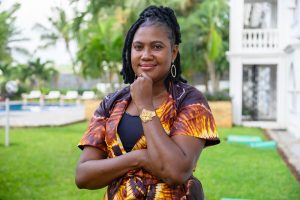
In 2018, as families had fled their homes amid Cameroon’s Anglophone crisis, Julien Ngum Che, a gender advocate and researcher from the southwest region of Cameroon, began working on the ground to support and defend the rights of the most affected. For more than eight years, her organization, ORGEM, has been developing initiatives to assist and empower internally displaced women and youth in Cameroon to restore their dignity, rebuild their lives…
For over a decade, Julien Ngum Che has worked at the intersection of civil society action and academic research, advocating for the rights of displaced women and young people in Cameroon. During the Anglophone crisis, while working on the ground, she began witnessing deep-rooted inequalities shaping the lives of women and young people in times of crisis. As they fled violence, they were dealing with deep trauma, having lost loved ones, homes, and livelihoods and struggling to survive with fewer resources and less protection. « Women and men face similar challenges, » she explains to Africa Women Experts, « but women face greater financial hardship. There is a wide poverty gap between men and women. When displacement happens, that gap widens. They also face heightened vulnerability to gender-based violence. All of this has a lasting impact and leads to further discrimination», she confides.
In 2018, she founded the Organization for the Empowerment of the Marginalized (ORGEM) to provide gender-responsive solutions to challenges faced by marginalized communities, especially displaced women and youth. The NGO works on gender-based violence (GBV) prevention and case management, while also bringing social support through climate-responsive initiatives such as smart agriculture…It also carries out leadership development programs to equip women and youth with the tools and knowledge to shape their future.
Changing lives initiatives
In the Subdivisions of Tiko (Southwest) and Bafut (Northwest), where her organization has been very active for the past years, she has led initiatives bridging gender and climate action. In 2021, the organization launched a renewable energy project in Bafut, partnering with civil society groups, NGOs, local authorities to install 100 solar units across the village. Beyond providing light, the project restored dignity, safety, and economic stability, particularly for women, she says. By reducing the need for long journeys into forests to collect firewood, access to renewable energy has also freed up time for women to pursue income-generating activities. « Women are disproportionately affected by climate change, especially rural and displaced women », she explains. « Integrating gender into climate action makes solutions more inclusive, sustainable and effective. When women lead climate adaptation and resilience efforts, entire communities benefit ».
In 2023, the NGO expanded its climate-responsive work by launching a smart agriculture project with internally displaced girls. Through vegetable and mushroom farming, rabbit production, and fertilizer-free practices, the initiative equipped internally displaced girls with practical skills and a start-up capital to launch their own poultry and mushroom farms. In addition, the organization led a back-to-school initiative for more than 300 displaced students, partnering with schools and churches, providing school supplies, covering fees and facilitating their return to the classroom.
Ending gender- based violence among displaced women
Amid the crisis, one of the Cameroonian advocate’s key interventions for displaced women has been addressing gender-based violence (GBV). As traditional cultural protection systems are weakened during crises, cases of sexual and physical abuse generally increase during these periods. « When I visited the court, I was struck by the number of cases from 2016 to 2019, » she recalls. Over the past years, her organization has handled around 40 gender-based violence cases.
Drawing on her experience tackling gender-based violence in displacement settings, she currently pursues a PhD in sociology at the University of Buea, researching GBV among internally displaced persons. « My research provides evidence and insights into the realities of GBV among internally displaced persons. At the same time, my field experiences enrich my academic work. This synergy ensures that my interventions are practical and that my research contributes to policy and humanitarian programs, » she explains.
Through a pathway of resilience, overcoming security risks, funding challenges, and cultural barriers, she has provided support to internally displaced women and youth in Cameroon, impacting their lives over the past years.
In 2025, her work promoting women’s rights through climate action earned her a fellowship with the African Women in Agricultural Research and Development (AWARD), a 15-month program designed to strengthen leadership, research, and networking among African women in leadership positions. That same year, she also received the Mawazo Fellowship, supporting African women researchers.
Looking ahead, Julien Ngum Che aspires to scale her impact nationally, championing gender-responsive climate and humanitarian initiatives and establishing a Gender Violence and Climate Response Training Center for marginalized communities in Cameroon.
Danielle France Engolo






 Menu
Menu